

7 Key Factors That Move Currency Prices
Fundamental analysis in forex
Successfully trading currency pairs isn’t just about reading charts and spotting your next entry. That’s part of the process — but if it were the whole process, everyone would get rich trading Forex.
To trade well, you also need to understand the fundamental factors that drive the pricing of currency pairs in the first place. Below, we break down seven of the biggest fundamental drivers behind every move in the Forex market, including where the major central banks stand on interest rates right now.
Fundamental analysis in forex
1. Economic Growth and Outlook
How an economy is growing — and what people expect for its future growth — matters enormously. Consumers, businesses, and governments are all part of this picture, and it helps to understand what each of these groups believes is happening.
How Sentiment Drives the Cycle
When sentiment is upbeat, consumers feel confident and spend more. Businesses take that revenue and spend it too — on wages, expansion, and investment. Governments benefit from the resulting tax revenue, and that revenue gets recycled through the economy as well. The whole system runs like a well-oiled machine.
The opposite happens in a weak economy: consumer spending slows, corporate profits shrink, layoffs increase, production declines, and tax revenues fall as companies tighten their belts.
Regardless of where a country sits in this cycle at any given moment, the health of its economy has a direct impact on the value of its currency.
Why GDP Is the Key Metric
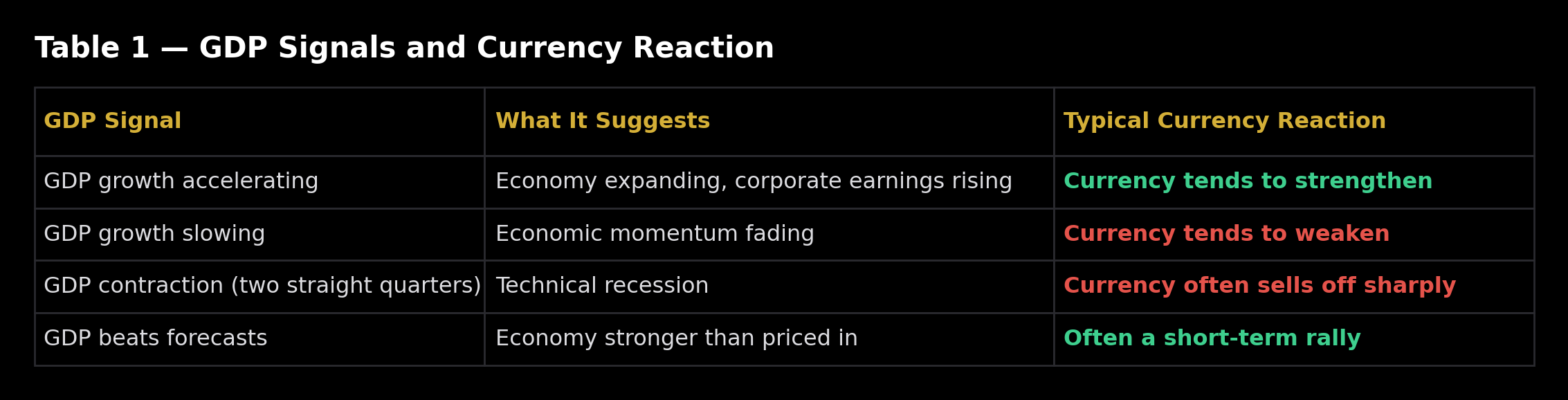
The most widely used gauge of economic growth or decline is Gross Domestic Product (GDP) — the total monetary value of all goods and services produced within a country, most often measured over a one-year period. GDP gives traders a fast way to compare the relative size and growth trajectory of different economies.
Table 1 — GDP Signals and Currency Reaction
2. Capital Flow
Money moves around the world faster than ever. A trader can click a few buttons and route funds into virtually any market, and plenty of Forex participants actively trade through hubs like the London or New York exchanges even when investing in currencies tied to entirely different regions.
Positive vs. Negative Capital Flow
Capital flow describes how money moves through global markets as traders, institutions, and governments shift funds between countries. What matters most is whether a country has a positive or negative capital flow balance.
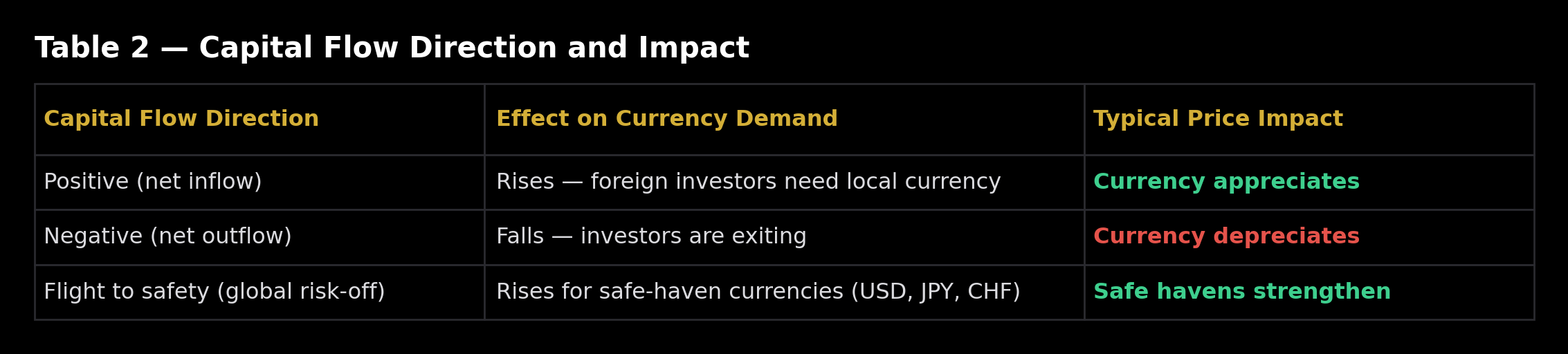
A positive capital flow means more foreign investment is entering a country than is leaving it. That raises demand for the local currency, since foreign investors need to acquire it before they can invest — a generally bullish sign for that currency’s value.
A negative capital flow means more money is leaving than entering. Demand for the currency weakens while supply stays strong, which tends to push its value down.
Table 2 — Capital Flow Direction and Impact
Fundamental analysis in forex
3. Trade Flow and Trade Balance
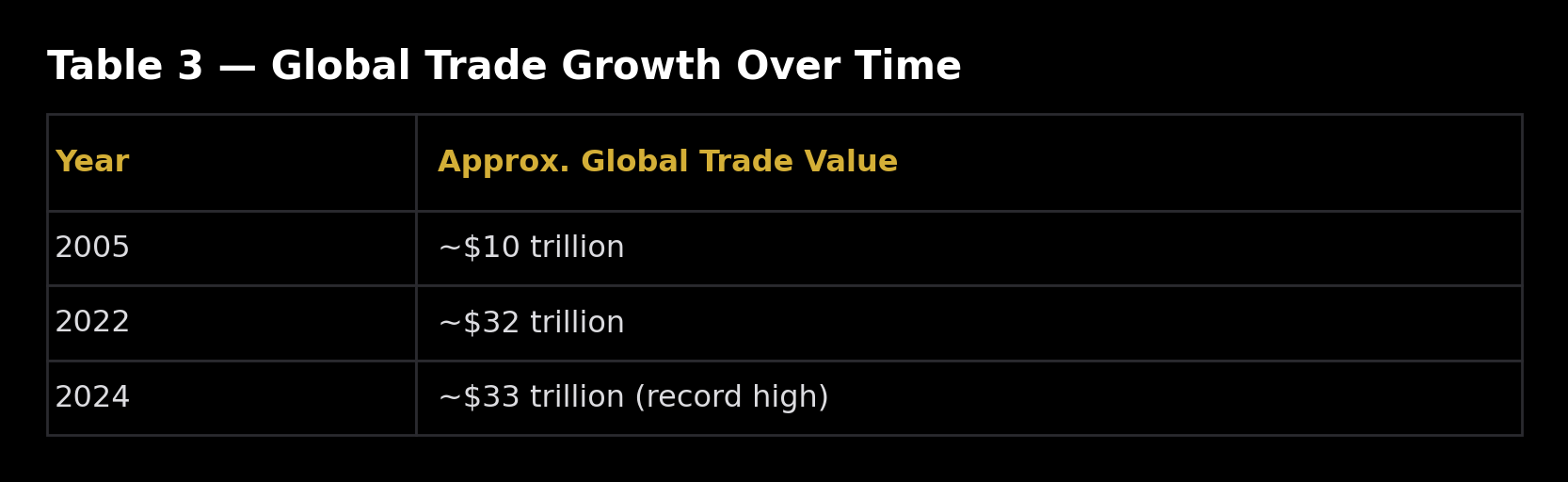
Global trade has grown enormously in scale. World trade in goods and services combined reached an estimated $33 trillion in 2024 — an all-time high — up roughly 3.3% from the prior year, with goods trade accounting for around $25 trillion and services making up the remaining $8 trillion.
Table 3 — Global Trade Growth Over Time
Trade Surplus vs. Trade Deficit
The trade ratio measures the balance between a country’s exports and imports. Is a country a net importer, bringing in more than it sells abroad? Or a net exporter, selling more than it buys? The answer helps explain a lot about currency valuation.
If exports exceed imports, the country runs a trade surplus. If imports exceed exports, it runs a trade deficit.
Table 4 — Trade Position and Currency Effect

No one can predict currency markets with certainty. But understanding a country’s trade surplus or deficit — and how it’s trending — gives traders a meaningful edge in reading the fundamental backdrop.
4. Interest Rates and Central Bank Policy
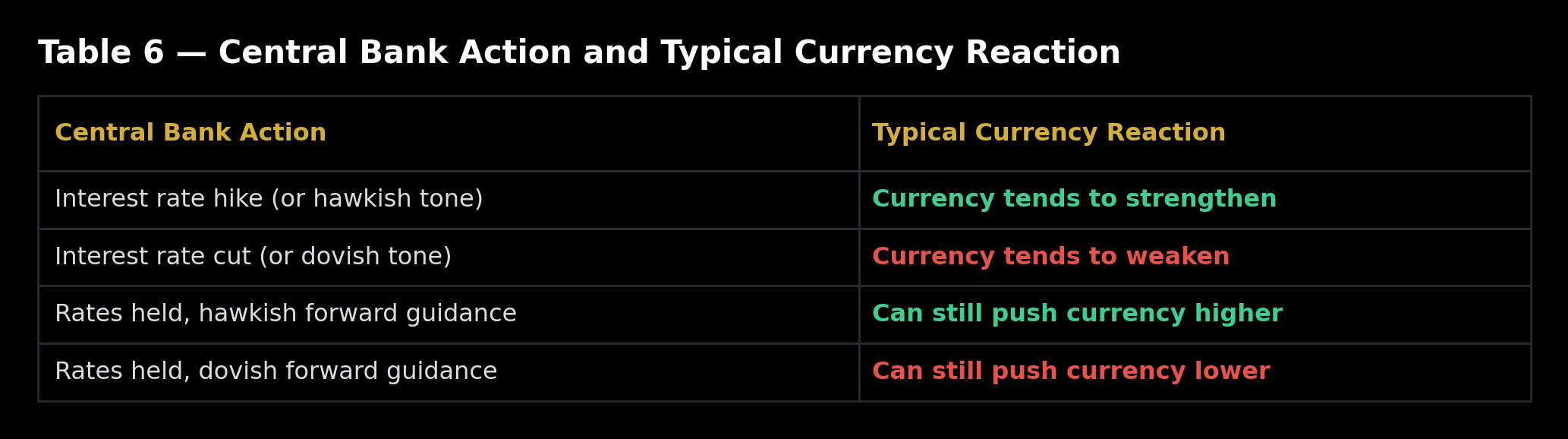
Interest rates set by central banks are one of the single biggest drivers of currency value. Higher interest rates tend to attract foreign capital seeking better returns on deposits and bonds, which increases demand for that currency. Lower rates tend to have the opposite effect, often encouraging capital to seek yield elsewhere.
Traders watch central bank meetings, rate decisions, and — just as importantly — the tone of official communication (often called “forward guidance”) for hints about where rates are headed next. Markets frequently move more on the expectation of a rate change than on the announcement itself.
Current Major Central Bank Rates
Table 5 — Current Major Central Bank Rates (as of July 31, 2026)
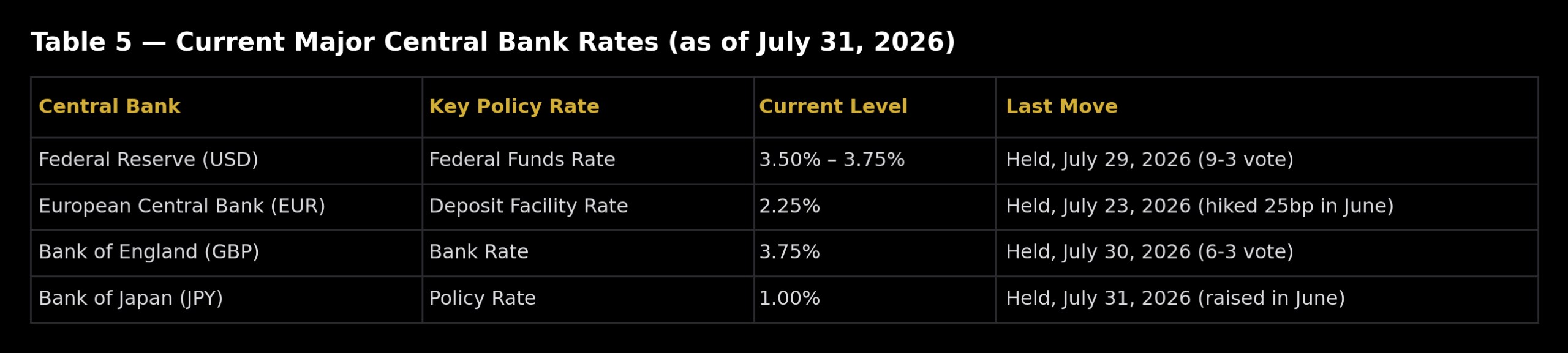
The ECB is currently the only major Western central bank to have raised rates during this cycle, doing so in June 2026 in response to an energy-driven inflation shock. The Fed, BoE, and BoJ have all held steady at their most recent meetings, though each has seen internal dissent in favor of hiking. Rates change frequently — verify current levels before publishing or trading on this data.
Fundamental analysis in forex
How Central Bank Moves Typically Affect Currencies
Table 6 — Central Bank Action and Typical Currency Reaction
5. Inflation
Inflation — the rate at which prices for goods and services rise — has a direct and complex relationship with currency value. Moderate, well-managed inflation is normal in a healthy economy. But when inflation runs too hot, it erodes purchasing power and often forces central banks to raise interest rates in response, which can push currency values in either direction depending on how the situation unfolds.
Persistently high inflation relative to other countries tends to weaken a currency over the long run, since it erodes the currency’s real value and purchasing power. Traders typically watch metrics like the Consumer Price Index (CPI) and Producer Price Index (PPI) for early signals.
Learn more: U.S. Bureau of Labor Statistics — CPI data
6. Political Stability and Geopolitical Risk
Currencies are, in a sense, a reflection of confidence in the country issuing them. Political stability, predictable policy, and strong institutions tend to support a currency, while political turmoil, contested elections, sudden policy shifts, sanctions, or armed conflict tend to undermine it.
Geopolitical shocks — wars, trade disputes, sanctions regimes — can trigger rapid, outsized currency moves that have little to do with the underlying economic data. This is why many professional traders track political and policy risk alongside the traditional economic calendar.
7. Employment Data
Labor market health — unemployment rates, job creation figures, and wage growth — is closely tied to consumer spending, which in turn feeds back into GDP. Strong employment data is generally read as a sign of economic strength, supporting the currency, while rising unemployment tends to be read as a warning sign.
In the U.S., the monthly Non-Farm Payrolls (NFP) report is one of the most closely watched releases in the entire Forex calendar, often producing sharp, immediate volatility across major pairs.
Learn more: U.S. Bureau of Labor Statistics — Employment Situation report
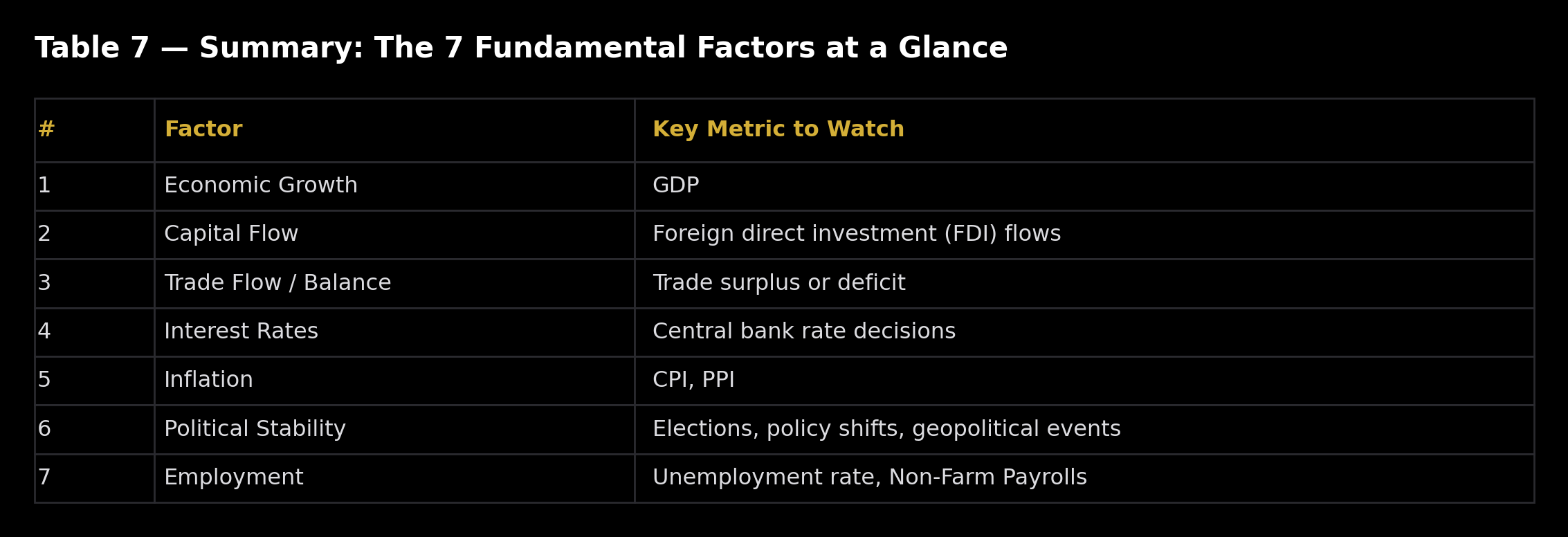
Quick Reference: The 7 Fundamental Factors at a Glance
Table 7 — Summary Table
Frequently Asked Questions Fundamental analysis in forex
What is fundamental analysis in Forex trading?
Fundamental analysis in Forex is the study of economic, financial, and political factors — like GDP, interest rates, trade balances, and political events — that influence a currency’s value, as opposed to technical analysis, which studies price charts and patterns.
Which fundamental factor moves currency prices the most?
Interest rate decisions from major central banks are widely considered the single most influential fundamental factor, since they directly affect global capital flows and investor returns. That said, no single factor works in isolation — they interact constantly.
How does GDP affect currency value?
Strong GDP growth signals a healthy, expanding economy, which tends to attract foreign investment and increase demand for the local currency. Weak or contracting GDP tends to have the opposite effect.
What’s the difference between a trade surplus and a trade deficit?
A trade surplus means a country exports more than it imports, which tends to support its currency. A trade deficit means it imports more than it exports, which can weigh on the currency over time.
What are the current interest rates for the major central banks?
As of July 31, 2026: the Federal Reserve holds at 3.50%–3.75%, the European Central Bank holds at 2.25%, the Bank of England holds at 3.75%, and the Bank of Japan holds at 1.00%. See Table 5 above for details and sources. These levels change regularly, so always check the linked central bank sources for the latest decision.
Can fundamental analysis be combined with technical analysis?
Yes — many experienced traders use fundamentals to determine the broader directional bias for a currency pair, then use technical analysis to time specific entries and exits.
Is fundamental analysis more useful for short-term or long-term Forex trading?
Fundamentals generally matter more for medium- to long-term positioning, since economic trends unfold over weeks and months. Short-term traders still need to watch high-impact fundamental events (like rate decisions or NFP releases), since these can cause sharp short-term volatility.
Further Reading on fundamental analysis in forex
- Federal Reserve — Selected Interest Rates (H.15)
- European Central Bank — Monetary Policy Decisions
- Bank of England — Interest Rates and Bank Rate
- Bank of Japan — Monetary Policy Meeting Decisions
- UNCTAD — Key Statistics and Trends in International Trade
- U.S. Bureau of Economic Analysis — GDP Data
- U.S. Bureau of Labor Statistics — CPI
- U.S. Bureau of Labor Statistics — Employment Situation (NFP)
- IMF — Balance of Payments Data
- U.S. Census Bureau — International Trade Data
Fundamental analysis Explained


Add comment