

Risk Management Strategies in Trading: The Foundation of Long-Term Success
Risk Management Strategies
Ask any trader who has been in the markets for a decade what separates the survivors from the casualties, and you’ll rarely hear “a brilliant strategy” or “a gift for picking winners.” You’ll hear about risk management. It’s the unglamorous discipline that determines whether a string of losses ends a career or barely dents an account. This article breaks down the core strategies that professional and disciplined retail traders rely on to stay in the game long enough to let their edge play out.
Risk Management Strategies
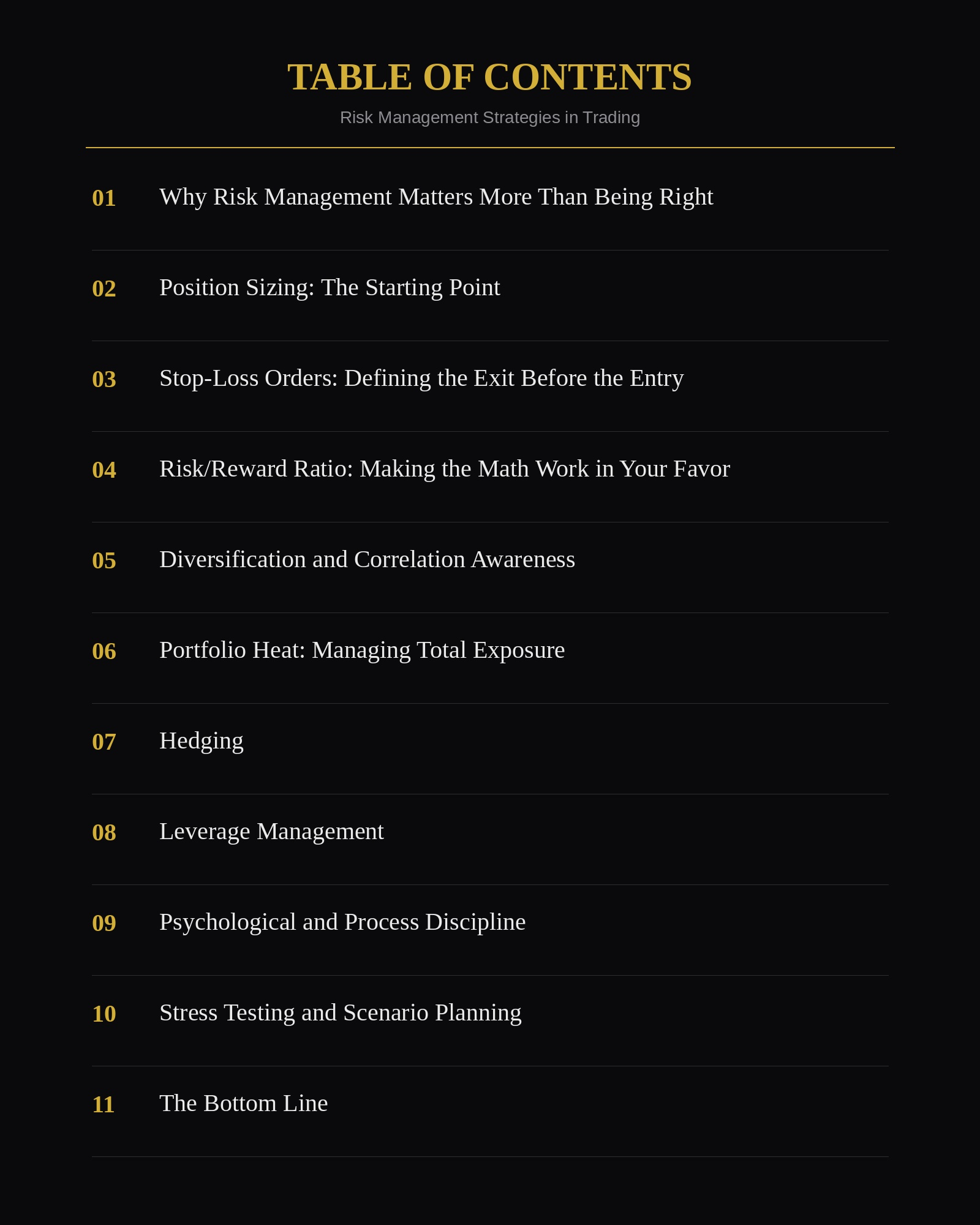
Why Risk Management Matters More Than Being Right
A common misconception among new traders is that success comes from being right more often than wrong. In reality, many profitable traders are right on fewer than half their trades. What keeps them profitable is that their losses are small and controlled while their wins are allowed to run. Risk management is the machinery that makes this asymmetry possible. Without it, even a strategy with a genuine statistical edge can be destroyed by a handful of oversized losses.
Position Sizing: The Starting Point
Every risk management framework begins with a simple question: how much capital should be exposed on any single trade? Position sizing answers that question and is arguably the most important decision a trader makes, more important than entry timing or even the strategy itself.
The most widely cited guideline is the 1-2% rule . Never risking more than 1-2% of total account equity on a single position. On a $50,000 account, that caps the loss on any one trade at $500 to $1,000, regardless of how confident the setup looks.
More sophisticated traders use fixed fractional sizing. It is where position size is recalculated as a percentage of current equity rather than the original account balance. This means positions shrink automatically during a losing streak and grow during a winning one, creating a natural braking system against compounding losses.
Volatility-based sizing goes a step further by adjusting position size to the specific instrument’s price behavior, often using the Average True Range (ATR). A highly volatile stock gets a smaller position than a stable one, so the dollar risk stays roughly consistent across very different assets.
Stop-Loss Orders: Defining the Exit Before the Entry
A stop-loss is a predetermined price at which a losing trade is closed automatically, and setting one before entering a trade — not after watching it move against you — is what separates a plan from a hope.
- Hard stops sit as live orders in the market and execute automatically, removing emotion from the exit decision entirely.
- Trailing stops move in the direction of a profitable trade, locking in gains while still guarding against a reversal.
- Mental stops rely on the trader’s own discipline to exit manually. They’re riskier because they depend on willpower in the heat of the moment, though some traders use them in thin or illiquid markets to avoid being picked off by stop-hunting.
The specific method matters less than the commitment to using one consistently. A stop-loss that gets moved further away every time price approaches it isn’t a risk management tool — it’s a delay tactic.
Risk/Reward Ratio: Making the Math Work in Your Favor
Before entering any trade, disciplined traders calculate the ratio between what they stand to lose and what they stand to gain. A common target is a minimum of 1:2 or 1:3 — risking one dollar to make two or three.
This ratio is what allows a trader to be wrong more often than right and still come out ahead. A trader who wins 40% of the time but maintains a 1:3 risk/reward ratio will be profitable over a large enough sample size, while a trader who wins 60% of the time but risks two dollars to make one will eventually go broke. The math, not the win rate, is what determines long-term viability.
Diversification and Correlation Awareness
Spreading capital across uncorrelated assets, sectors, or strategies reduces the odds that a single event can devastate an entire portfolio. In trading, this principle requires more nuance than it does in long-term investing, because correlation between positions can be hidden.
Being long five different technology stocks might look diversified on paper, but if they all move together during a sector-wide selloff, the trader is effectively holding one oversized position with five names attached to it. Real diversification means understanding how positions actually behave relative to one another, not just how many different tickers appear in the account.
Portfolio Heat: Managing Total Exposure
Position sizing controls risk on individual trades, but portfolio heat controls total risk across everything open at once. A common guideline caps aggregate exposure at 5-6% of account equity across all simultaneous positions.
This matters because correlated losses can stack quickly. Five positions each risking 1% might seem conservative individually, but if all five are exposed to the same underlying market shock, the trader could face a 5% drawdown in a single event — which is exactly the scenario portfolio heat limits are designed to prevent.
Hedging
Hedging involves taking an offsetting position . Through options, inverse ETFs, or futures — to protect a core holding without necessarily closing it. A trader holding a large long position in a stock might buy put options as insurance against a sharp decline. Accepting the cost of the hedge in exchange for defined downside protection. Hedging is more commonly used by larger or more sophisticated traders, since it adds cost and complexity, but it’s a critical tool when a position can’t or shouldn’t be exited outright.
Leverage Management
Leverage magnifies both gains and losses, and mismanaged leverage is one of the most common reasons traders fail. A strategy that would survive a normal drawdown unleveraged can trigger a margin call and forced liquidation when leverage is applied carelessly. Respecting leverage limits — and understanding that borrowed capital changes the math of every other risk rule — is essential, particularly in markets like forex and futures where high leverage is readily available.
Psychological and Process Discipline
The most sophisticated risk framework in the world fails if it isn’t followed under pressure. Process discipline is what keeps the rest of the system intact:
- Following a written trading plan instead of improvising in the moment
- Avoiding revenge trading — increasing size or abandoning rules after a loss in an attempt to win it back quickly
- Setting a maximum daily or weekly loss limit that forces a stop when hit
- Keeping a trading journal to track what is actually working, as opposed to what feels like it’s working
Emotional decision-making under stress is where most risk management breakdowns happen. Even among traders who understand the rules perfectly well on paper.
Stress Testing and Scenario Planning
Finally, disciplined traders test their strategies against historical worst-case scenarios. Like the 2008 financial crisis, the 2020 pandemic crash, flash crashes . To understand how a given approach would have performed under extreme stress. This isn’t about predicting the next crisis, but about knowing, in advance, roughly how bad “bad” can get, so a real drawdown doesn’t come as a shock that triggers panic-driven decisions.
The Bottom Line
Risk management isn’t a single tactic but a layered system. Position sizing controls individual trade exposure, stop-losses define the exit, risk/reward ratios ensure the math favors the trader over time. Diversification and portfolio heat limits guard against correlated losses. Hedging and leverage management address structural risk, and psychological discipline holds the entire system together under pressure. No strategy, however well-researched, survives long without this scaffolding around it. The traders who last aren’t the ones who never lose — they’re the ones who’ve made sure no single loss, or string of losses, can end the game.
Risk Management Strategies
This article is for educational purposes only and does not constitute financial advice. Trading involves substantial risk of loss. Individuals should consider their own financial situation and risk tolerance, or consult a licensed financial advisor, before making trading decisions.


