

Investments for Beginners: The Complete 2026 Guide to Getting Started
Investments for Beginners
Introduction: Investments for Beginners – Why Investing Matters More Than Ever
If you’ve ever typed “investments for beginners” into a search bar, you’re already ahead of most people your age. The truth is, saving money in a bank account alone won’t build real wealth — inflation quietly erodes the value of cash sitting idle. Investing is how ordinary people turn small, consistent contributions into meaningful long-term wealth.
This guide is written specifically for people who have never invested a dollar before. By the end, you’ll understand what investing actually means, which asset classes exist, how much money you need to start, and a realistic step-by-step plan you can follow this week — not “someday.”
What Does “Investing” Actually Mean?
At its core, investing means putting your money into an asset today with the expectation that it will grow in value or generate income over time. Instead of your money sitting still, it works for you.
There are two broad ways investments make you money:
- Capital appreciation — the asset itself becomes more valuable (a stock price rises, a property increases in value).
- Income generation — the asset pays you regularly (dividends from stocks, interest from bonds, rent from real estate).
Most successful long-term investors benefit from a combination of both.
Investing vs. Saving: Know the Difference
A common mistake beginners make is confusing saving with investing.
- Saving means setting money aside in a low-risk, easily accessible place, like a savings account. It’s ideal for short-term goals and emergencies.
- Investing means accepting some level of risk in exchange for the potential of higher returns over a longer time horizon.
As a rule of thumb, keep 3–6 months of living expenses in a savings account as an emergency fund before you start investing. Investing money you might need next month is a common and painful beginner mistake, because markets can and do drop in the short term.
The Main Types of Investments Explained
Understanding the major asset classes is the foundation of any solid beginner investing strategy.
1. Stocks (Equities)
When you buy a stock, you’re buying a small ownership stake in a company. Stocks have historically offered the highest long-term returns of any major asset class, but they also come with higher short-term volatility.
- Best for: Long-term growth (5+ years)
- Risk level: Medium to high
- Beginner tip: Instead of picking individual stocks, most beginners are better served by low-cost index funds that own hundreds of companies at once.
2. Bonds (Fixed Income)
Bonds are essentially loans you give to a government or company in exchange for regular interest payments and the return of your principal at maturity.
- Best for: Stability and income
- Risk level: Low to medium
- Beginner tip: Bonds help balance out the volatility of stocks in a portfolio, which is why they’re often paired together.
3. Exchange-Traded Funds (ETFs) and Mutual Funds
These are baskets of stocks, bonds, or other assets bundled into a single investment. They offer instant diversification, which reduces risk compared to buying individual securities.
- Best for: Beginners who want diversification without picking individual stocks
- Risk level: Varies depending on the underlying holdings
- Beginner tip: Look for funds with low expense ratios (ideally under 0.20%), since fees compound against you over time just as returns compound in your favor.
4. Real Estate
Real estate investing can mean buying physical property, or investing indirectly through Real Estate Investment Trusts (REITs), which trade like stocks on an exchange.
- Best for: Income and diversification
- Risk level: Medium
- Beginner tip: REITs let you invest in real estate with far less capital and effort than buying physical property.
5. Cash Equivalents (Money Market Funds, CDs, T-Bills)
These are low-risk, short-term instruments that preserve capital while earning modest interest.
- Best for: Emergency funds and short-term goals
- Risk level: Very low
6. Alternative Investments
This category includes commodities like gold and silver, cryptocurrencies, and private equity. These can add diversification but typically carry higher risk and complexity, so most beginners should treat them as a small portion of a portfolio, if at all.
How Much Money Do You Need to Start Investing?
One of the biggest myths that stops beginners from starting is the belief that you need thousands of dollars. In reality, many brokerages now allow you to:
- Open an account with $0
- Buy fractional shares for as little as $1–$5
- Set up automatic recurring investments of small amounts weekly or monthly
Consistency matters far more than the size of your first investment. Someone who invests $50 a month starting today will often outperform someone who waits years to save up a “big enough” amount to start.
Understanding Risk and Time Horizon
Every investment carries some level of risk, and understanding your personal risk tolerance and time horizon is essential before you put money to work.
- Time horizon is how long you plan to keep the money invested before you need it.
- Risk tolerance is your emotional and financial capacity to handle market fluctuations without panic-selling.
Investments for Beginners
As a general guideline:
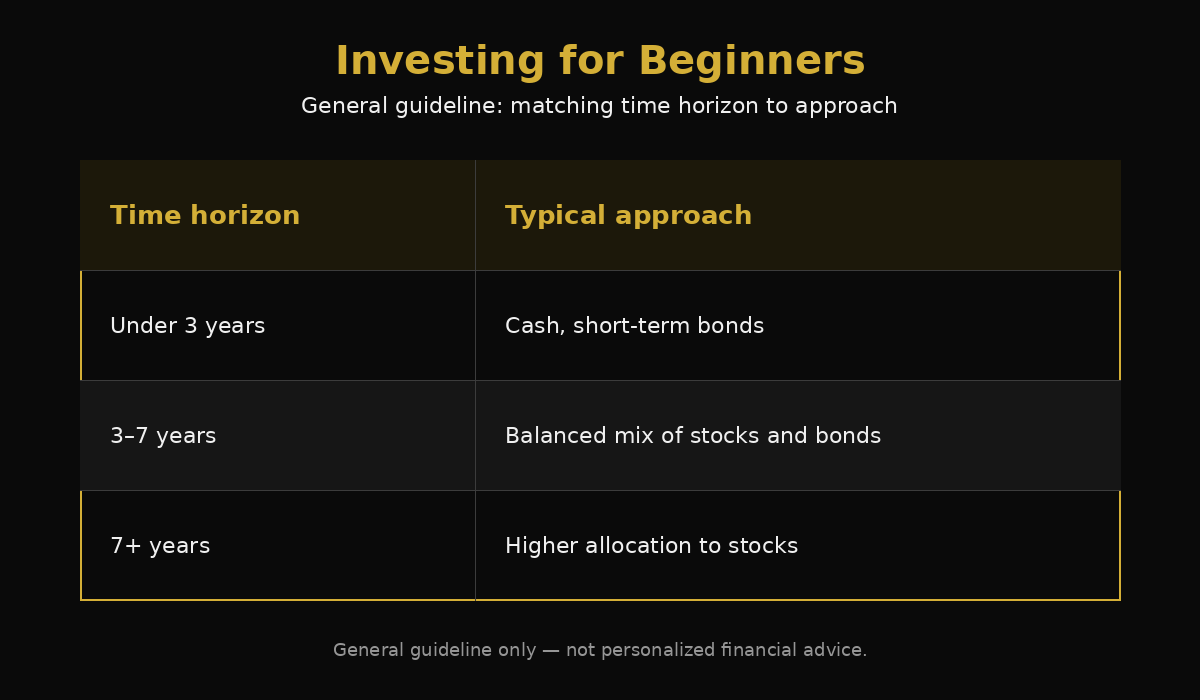
The longer your time horizon, the more short-term volatility you can typically afford to accept, since markets have historically trended upward over long periods despite short-term downturns.
The Power of Compound Growth
Compounding is often called the eighth wonder of the financial world, and for good reason. When your investment returns start generating their own returns, growth accelerates over time.
For example, investing $200 a month starting at age 25 versus starting at age 35 can result in a dramatically larger nest egg by retirement, even though the 25-year-old invested for only 10 extra years. Time in the market, not timing the market, is what drives compounding.
A Simple Step-by-Step Plan for Beginners
Step 1: Build a Small Emergency Fund
Aim for at least one month of expenses before investing anything, and continue building toward 3–6 months over time.
Step 2: Define Your Goals
Are you investing for retirement, a home down payment, or general wealth building? Your goal determines your time horizon and risk approach.
Step 3: Choose the Right Account
Depending on your country, tax-advantaged accounts (such as retirement accounts) may offer significant benefits over standard taxable brokerage accounts.
Step 4: Pick a Brokerage
Look for low fees, a simple interface, fractional share access, and good educational resources.
Step 5: Start with Diversified Funds
Rather than trying to pick winning individual stocks, many beginners start with broad-market index funds or ETFs to reduce risk.
Step 6: Automate Your Contributions
Setting up automatic transfers removes emotion from the process and builds the habit of consistent investing.
Step 7: Review, Don’t Obsess
Check your portfolio periodically — quarterly or semi-annually is plenty. Checking daily often leads to emotional, reactive decisions.
Common Mistakes Beginner Investors Should Avoid
- Trying to time the market. Even professional investors struggle to consistently predict short-term market movements.
- Chasing hot tips or trends. Decisions based on hype rather than research often end poorly.
- Ignoring fees. High fund expense ratios or trading fees quietly erode returns over decades.
- Lack of diversification. Putting all your money into one stock or sector significantly increases risk.
- Panic selling during downturns. Selling after a drop locks in losses and forfeits the eventual recovery.
- Not starting at all. Waiting for the “perfect time” to invest is one of the costliest mistakes of all, since it usually just means lost time in the market.
Diversification: Don’t Put All Your Eggs in One Basket
Diversification means spreading your money across different asset classes, sectors, and geographic regions so that a decline in one area doesn’t sink your entire portfolio. A diversified beginner portfolio might include a mix of domestic stocks, international stocks, and bonds, adjusted according to age and risk tolerance.
A commonly referenced (though not universal) starting framework is the “110 minus your age” rule, where that percentage goes into stocks and the remainder into bonds — though personal circumstances should always be factored in.
Active vs. Passive Investing
- Passive investing involves buying and holding diversified funds that track a market index, aiming to match market returns with minimal effort and low fees.
- Active investing involves attempting to outperform the market through stock picking, market timing, or frequent trading.
Historically, the majority of actively managed funds fail to beat their passive benchmark index over long periods, once fees are factored in. For this reason, most beginners are well served by starting with a passive, low-cost approach and gradually learning more as their confidence and knowledge grow.
Frequently Asked Questions
Is it better to pay off debt or invest first? High-interest debt, such as credit cards, should typically be paid off first, since the interest rate often exceeds typical investment returns. Lower-interest debt, like some mortgages, can sometimes be managed alongside investing.
How much should a beginner invest each month? There’s no universal number — what matters most is consistency. Many beginners start with a percentage of income, such as 10–15%, and increase it over time.
Can I lose all my money investing? Diversified investments like broad-market index funds are highly unlikely to go to zero, though they can decline significantly in value during downturns. Concentrated bets on single stocks or speculative assets carry far higher risk of severe loss.
Do I need a financial advisor to start investing? Not necessarily. Many beginners successfully start on their own using low-cost brokerages and diversified funds, though an advisor can be valuable for complex financial situations.
Final Thoughts on Investments for Beginners
Investing for beginners doesn’t require a finance degree, a large sum of money, or perfect timing. It requires a basic understanding of the main asset classes, a realistic plan matched to your goals and risk tolerance, and — most importantly — the discipline to start early and stay consistent. Markets will rise and fall, but a patient, diversified, long-term approach has historically rewarded those who stay the course.
The best time to start investing was years ago. The second-best time is today.
About the Author
Bobby Jovanovski has over 35 years of experience in trading, technical and political analysis, and the development of charting systems and trading stations, with a background centered on Forex, precious metals, and bonds. He has run his own trading fund and has tutored traders of all levels — from complete beginners to experienced professionals and introducing brokers (IBs) — through Smart Investing and Trading.
Disclaimer: This article is for educational purposes only and does not constitute personalized financial or investment advice. Investing involves risk, including potential loss of principal. Consider consulting a licensed financial advisor before making investment decisions.


Add comment