

The Seashells of the Digital Age: What Bitcoin Actually Needs to Grow Up
Is Bitcoin a safe haven
Forty years in global markets teaches you one thing above all: every generation invents a new asset class that the previous generation swears is a fad. Tulips. Railway stock. Dot-com tickers with no revenue. And now, digital coins that live on a ledger nobody can touch.
So — is crypto here to stay, a pyramid scheme in a hoodie, or something in between? After three decades specializing in currency markets, my honest answer is: it’s a fourth thing entirely, and most of the debate is really an argument about which box to force it into.
Is Bitcoin a safe haven
The Google Test
Search “types of investments” and you’ll get the standard textbook list — stocks, mutual funds, real estate, bonds, fixed deposits. Bitcoin doesn’t show up. Not because it’s irrelevant, but because it doesn’t fit any of the boxes we built before it existed. That’s not a knock against it. It’s the whole problem in one sentence.
Currency, Commodity, or Campfire Story?
Call Bitcoin a “currency” all you like — the label doesn’t make it behave like one. A currency needs something to anchor confidence in it: a government’s taxing power, a central bank’s promise, an economy behind the paper. Bitcoin has none of that. What it has is scarcity by design and a global network of believers, which puts it closer to a collectible than a currency — you could just as easily hand someone a rare seashell and insist it’s money, and it would “work” for exactly as long as the other person agreed to play along.
Gold is the closer cousin. It’s scarce, it’s been trusted across borders and empires for millennia, and it doesn’t need anyone’s permission to be valuable. But even that comparison has a wide gap: all the gold ever mined on Earth — every bar, coin, and wedding ring — is worth somewhere in the neighborhood of $29–31 trillion today. Bitcoin’s entire market is worth around $1.3 trillion. Gold isn’t just older money — it’s roughly twenty times bigger money, and gold’s floor comes from thousands of years of humans agreeing on its worth across every civilization that’s existed. Bitcoin has had one bull run of internet history.
So call it what it actually is: somewhere between a commodity, a speculative vehicle, and a very well-marketed idea. That’s not an insult — commodities and speculative vehicles have made and lost fortunes for centuries. It’s just not “the future of money” in the way the loudest voices on social media insist it is. At least not yet.
The Whale Problem Nobody Wants to Talk About
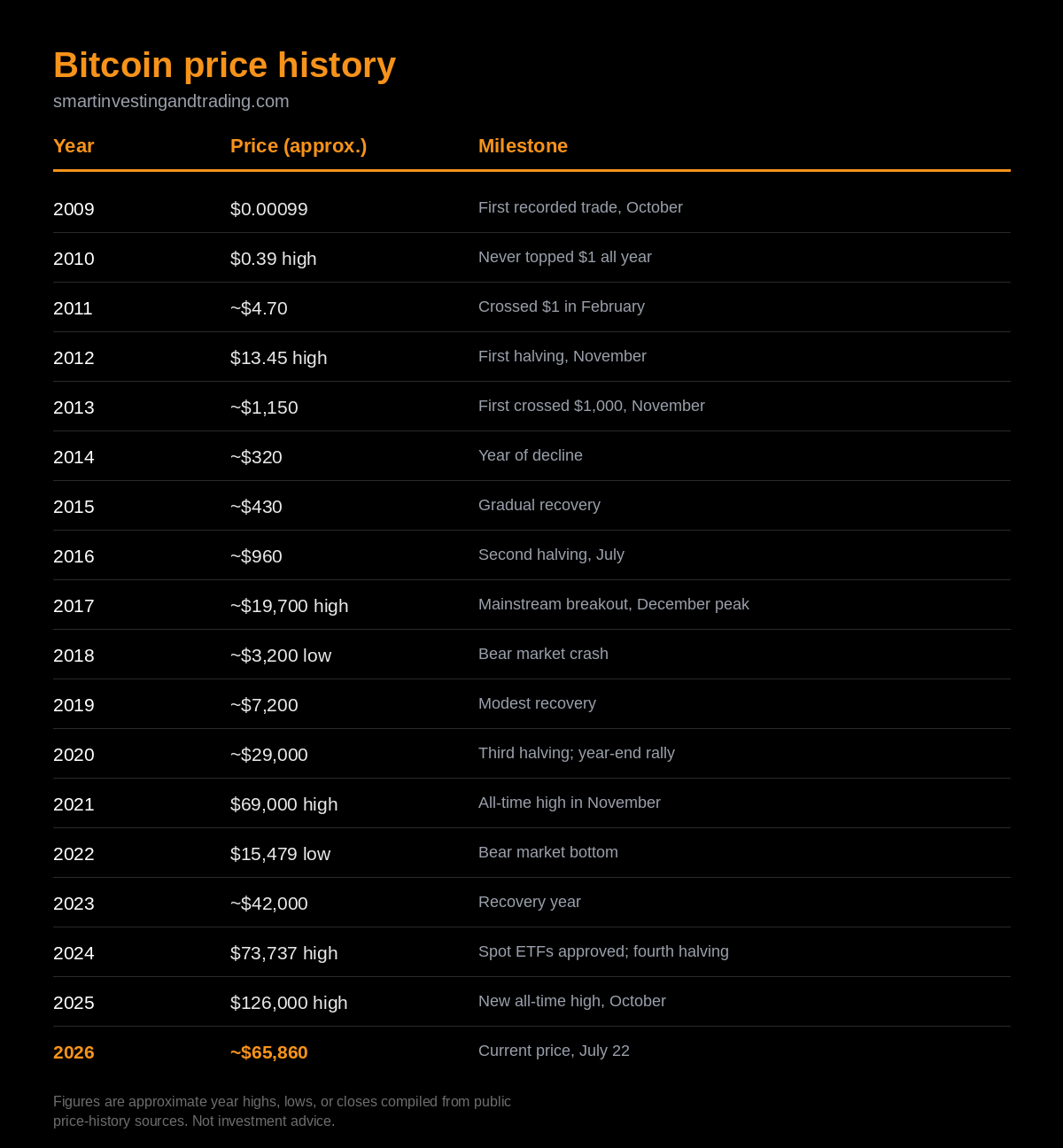
Here’s the uncomfortable truth about who actually holds Bitcoin: a relatively small number of large wallets control an outsized share of the supply. When concentration like that exists in any market — stocks, real estate, art — a handful of holders can move price far more than fundamentals justify. That’s not a conspiracy theory, it’s just market structure. And it’s precisely why Bitcoin can lose a third or half of its value in a matter of months, which it has done more than once. In the past year alone, the price has swung from a peak above $126,000 down toward the $60,000s — a drawdown of roughly 40% that would make most stock or bond investors’ stomachs turn.
Wide, distributed ownership is what turns “asset that a few people can crash on a whim” into “asset that’s actually stable.” Right now, Bitcoin is still closer to the former.
The “Split” Idea — Clever, But Already Solved
The essay that inspired this piece raised something genuinely interesting: could Bitcoin do something like a stock split, the way companies do to make expensive shares more accessible to ordinary buyers? It’s a great question — and it turns out crypto solved it before the question was even asked.
You don’t need to own a whole Bitcoin to own Bitcoin. Every coin is divisible into 100 million units called satoshis, which means you can buy $20 of Bitcoin as easily as you can buy $20,000 of it. There’s no “waiting for the company’s board to approve a split” — the divisibility has been baked into the protocol since 2009. So the barrier to entry was never really the sticker price of one whole coin. The real barrier is something else entirely: trust, custody, and understanding what you’re actually holding.
Is Bitcoin a safe haven
What a Real Safe Haven Requires — and Why Bitcoin Isn’t One Yet
A safe haven asset is supposed to hold or gain value when everything else is falling apart — the way gold, government bonds, and the Swiss franc have historically done during recessions and crises. Bitcoin advocates love to call it “digital gold,” but the data doesn’t back that up consistently: during several recent market shocks, Bitcoin has fallen right alongside stocks rather than acting as a hedge against them. An asset that can lose 40% of its value in a year isn’t functioning as insurance — it’s functioning as a high-beta bet on risk appetite.
Gold’s advantage isn’t mystical. It’s physical, it’s held real value across the collapse of empires and currencies, and — as the original essay pointed out — it doesn’t need electricity, an internet connection, or a working exchange to exist. That’s a genuinely fair point, even if the doomsday scenario behind it is one nobody hopes to test.
So What Would It Actually Take?
Strip away the hype and the panic, and Bitcoin’s path to legitimacy probably runs through a few concrete things:
- Distributed ownership. Fewer mega-wallets, more everyday holders, so price reflects broad demand rather than a handful of decisions.
- Institutional plumbing. Regulated exchanges, clear custody rules, and enforceable standards — the “official exchange with rules everyone obeys” the original essay called for. Spot Bitcoin ETFs were a real step in this direction, giving ordinary investors regulated exposure without needing to manage a digital wallet themselves.
- Regulatory clarity without capture. Rules that protect investors without simply recreating the government-backed promise crypto was originally built to avoid.
- Time. Gold’s trust was built over millennia. Bitcoin is seventeen years old. Even the most successful asset classes in history needed decades to earn the “safe” label — Bitcoin skipping that queue by sheer enthusiasm was always the least likely outcome.
The Bottom Line
Bitcoin isn’t a scam, and it isn’t the second coming of money, either. It’s a new kind of asset still figuring out what it wants to be when it grows up — scarce like gold, volatile like a tech stock, and dependent on a belief system that’s still being tested in real time. Whether it earns a permanent seat at the table depends less on the next headline-grabbing rally and more on the boring stuff: custody standards, regulation, and whether the next generation of holders is wider and steadier than the last.
History rarely rewards the loudest prediction. It rewards whichever version of the asset actually survives its own volatility long enough to become boring. Bitcoin hasn’t gotten there yet — but “not there yet” and “never will be” are very different bets.
Is Bitcoin a safe haven
Market data referenced: Bitcoin trading near $65,800–66,300 with a market cap of roughly $1.33 trillion as of late July 2026; global above-ground gold stock valued at approximately $29–31 trillion. Figures move daily — treat them as a snapshot, not a forecast.


Add comment