

How to Build a Trading Plan
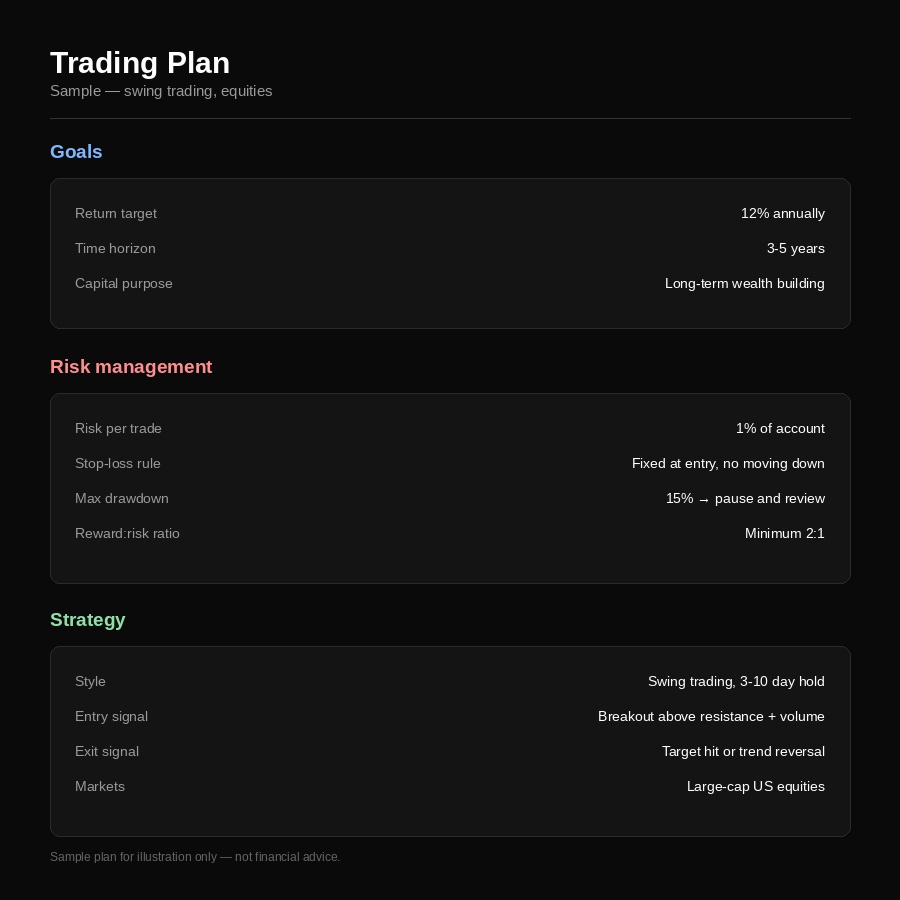
Trading Plan
Trading without a plan is a bit like setting out on a road trip with no map, no destination, and no idea how much gas is in the tank. You might get somewhere interesting, but you’re just as likely to end up stranded. A trading plan is the document — mental or written — that turns trading from a series of impulsive bets into a disciplined, repeatable process.
At its core, a good trading plan answers three questions before you ever place a trade: What am I trying to achieve? How much am I willing to lose? How will I actually make decisions? These map directly onto the three foundational components of any trading plan: Goals, Risk Management, and Strategies.
Why a Trading Plan Matters
Markets are noisy, emotional, and unpredictable in the short term. Without a plan, traders tend to make decisions reactively — chasing a rally out of fear of missing out, or holding a losing position too long out of hope it will “come back.” A written plan acts as an anchor. When emotions run high, you don’t have to think clearly in the moment; you just have to follow the rules you set when you were thinking clearly.
A trading plan also creates accountability. It gives you a benchmark to measure your actual performance against your intentions, which makes it possible to improve over time instead of just repeating the same mistakes.
Components of a Trading Plan
-
Goals: Define Your Financial Objectives
Every trading plan starts with a clear sense of purpose. Vague goals like “make money” don’t give you anything to act on. Instead, your goals should be specific, measurable, and realistic.
Consider defining:
- Return targets — What annual or monthly return are you aiming for? Is it a modest 8–10% to outpace inflation, or a more aggressive target tied to active trading?
- Time horizon — Are you trading for income this year, or building wealth over a decade? Short-term traders and long-term investors need very different plans.
- Purpose of the capital — Is this money earmarked for retirement, a house down payment, or discretionary income? The purpose shapes how much risk is appropriate.
- Skill and experience goals — Especially for newer traders, goals might include things like “master one strategy before adding a second” or “keep a trade journal for six months.”
Clear goals prevent scope creep — the tendency to drift from a calm, long-term plan into erratic, short-term speculation because a stock is “hot.”
-
Risk Management: Outline Your Risk Tolerance
If goals are the destination, risk management is the seatbelt. This is arguably the most important component of a trading plan, because it’s the piece that keeps a string of bad trades from turning into a catastrophic loss.
Key elements to define:
-
Risk per trade
— Many traders cap risk on any single trade at 1–2% of total capital. This ensures no single loss is devastating.
-
Position sizing
— How do you decide how many shares or contracts to buy, based on your account size and the risk per trade?
-
Stop-loss rules
— At what price will you exit a losing trade? Decide this before entering, not while emotions are running high.
-
Maximum drawdown limits
— At what point do you stop trading altogether to reassess — after a 10% account decline? 20%?
-
Diversification rules
— How much exposure will you allow to a single stock, sector, or asset class?
-
Risk-to-reward ratio
— A common guideline is to only take trades where the potential reward is at least 2–3 times the potential risk.
Risk management doesn’t guarantee profits, but it guarantees survival — and survival is what allows a good strategy the time it needs to prove itself.
-
Strategies: Specify Your Trading Methods
This is the “how” of your plan — the specific, repeatable methods you’ll use to enter and exit trades. A strategy removes guesswork by defining exact conditions for action.
Your strategy section should cover:
- Trading style — Day trading, swing trading, position trading, or long-term investing. Each requires different time commitments and tools.
- Entry criteria — What technical or fundamental signals trigger a buy? (e.g., a moving average crossover, a breakout above resistance, an earnings beat.)
- Exit criteria — Beyond stop-losses, what conditions signal it’s time to take profits?
- Markets and instruments — Will you trade stocks, options, forex, crypto, or futures? Specialization often beats spreading attention too thin.
- Analysis method — Technical analysis, fundamental analysis, or a blend of both?
- Trade documentation — A journal that records the reasoning behind each trade, the outcome, and lessons learned.
Having a defined strategy also makes it possible to backtest — to look at historical data and see whether your approach would have worked — before risking real capital.
Putting It All Together
A trading plan isn’t a static document you write once and forget. Markets evolve, and so should your plan. Review it regularly — many traders do this quarterly — to check whether your goals still make sense, whether your risk tolerance has changed, and whether your strategies are still performing as expected.
The traders who last aren’t necessarily the ones with the most exciting strategies — they’re the ones who show up with a plan, follow it with discipline, and adjust it thoughtfully over time.
This article is for educational purposes and does not constitute financial advice. Trading involves risk, and past performance is not indicative of future results.


