

Why a Company Can Erase $1.4 Billion of Debt and Watch Its Stock Fall 10%
The GameStop swap, explained in plain English — and what it teaches you about dilution
GameStop CorporationOn Monday, August 3rd 2026, GameStop announced it had wiped roughly $1.4 billion of debt off its books. It didn’t spend a single dollar of cash to do it. The stock fell more than 10%, touching $19.72 before steadying around $20.44.
If that seems backwards, you’re paying attention. Less debt is supposed to be good. Not spending cash is supposed to be good. Yet the market marked the shares down hard within minutes.
This happens often enough that it’s worth understanding properly, because you will see it again — in a small-cap biotech, in a leveraged retailer, in whatever the next crowded story stock turns out to be. The mechanics are always the same. GameStop just gives us an unusually clean example to learn from.
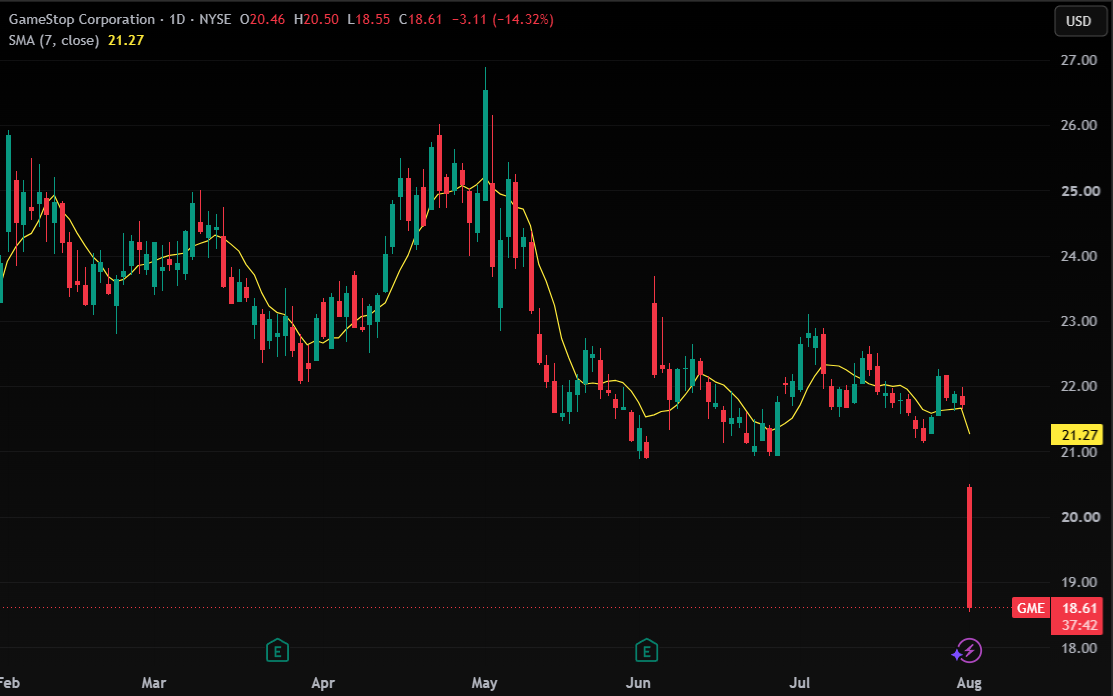
What actually happened with GameStop Corporation
GameStop owed money to a group of lenders. Instead of paying them back in cash, the company said: we’ll give you shares in the company instead, and we’ll call it even.
The lenders agreed. The debt gets cancelled. No cash leaves the building.
That’s a debt-for-equity swap. The company converts what it owes into what it is — turning a fixed obligation into ownership.
The specifics, so you can follow along:
- About $400 million of notes due 2030 and $1.0 billion of notes due 2032 are being handed back
- Both carried a 0% coupon — GameStop was paying no interest on any of it
- The deal was privately negotiated with a selected group of existing holders, not offered to the market
- It’s expected to close on or around September 23rd, 2026
The part that hurts
Think of a company as a pizza cut into eight slices. You own one slice.
The company doesn’t bake a new pizza to pay its lenders. It cuts the same pizza into twelve slices and hands four of them over. Your slice is now smaller. You didn’t sell anything, you didn’t do anything wrong, and you own less of the company than you did yesterday.
That’s dilution, and it’s the whole story behind the sell-off.
Put GameStop’s numbers on it. The company has roughly 448 million shares outstanding. If $1.4 billion of stock gets issued at somewhere near where the shares are currently trading — call it $20 — that’s around 70 million new shares, or roughly 15% more stock than existed on Friday.
Fifteen percent. That’s the size of the bite, and it’s why the market’s reaction was not an overreaction.
“No cash proceeds” sounds like the deal was free. It wasn’t free. Was paid for — just not by the company. It was paid for by everyone who already owned the stock, in a currency that doesn’t show up on any cash flow statement.
This is the single most useful thing to internalise: a company issuing shares is spending money it doesn’t have to record as an expense. The bill lands on shareholders directly.
Why these particular lenders made it worse
GameStop’s debt wasn’t ordinary debt. It was convertible notes — a loan that comes with a coupon attached, giving the lender the right to swap it for stock later, at a pre-agreed price.
That’s a meaningful distinction. A convertible note dilutes you only if the stock rises above that agreed price. If the shares never get there, the lender takes their money back and no new shares are ever created. The dilution is a maybe.
By doing this exchange now, the company turned a maybe into a definitely.
That’s the honest explanation for the drop, and it’s the one most headlines miss. Investors weren’t reacting to “dilution” in the abstract. They were reacting to optionality being converted into certainty — a risk that might never have materialised becoming a fact this morning.
And the interest savings? There weren’t any
These notes carried a 0% coupon. Zero. GameStop was borrowing over a billion dollars and paying nothing at all to hold it.
So when you read that the swap “improves the balance sheet,” ask the obvious follow-up: improves it how, exactly? There was no interest bill to escape. Nothing got cheaper.
This is a good habit generally. Debt reduction is only automatically good when the debt was costing something. Free money that isn’t due for six years is one of the least urgent problems a company can have.
It’s especially worth asking here, because GameStop was not a company under financial pressure. Its most recent quarter, reported in June, was the most profitable in its history: net income of $389.6 million, sales up 14% year on year on the back of collectibles, and roughly $9.7 billion in cash, marketable securities and digital assets on the balance sheet.
A company sitting on $9.7 billion could simply have paid this debt off in cash. It chose to pay in stock instead. That choice is the story — and it points directly at the next section.
What genuinely did improve
Be fair to the other side of it. Some real things changed:
- The maturity wall got shorter. Debt eventually comes due, and the company has to find cash on someone else’s timetable. Less debt means fewer forced decisions later.
- Refinancing risk fell. If credit markets are ugly in 2030, that’s no longer as much of a problem.
- Borrowing capacity opened up. Lenders look at how much you already owe. A cleaner balance sheet means more room to raise money for something else.
- The cash stayed put. Paying in stock preserves $1.4 billion of liquidity for other uses.
Those last two points are usually where the real motive lives. Companies rarely clean up their leverage for aesthetic reasons. They clean it up because they want to do something that requires a clean balance sheet.
When you see a swap like this, always ask what it’s making room for.
What GameStop is making room for
You don’t have to guess. Line up three facts from the past few months:
One. In May, GameStop made an unsolicited bid to buy eBay for about $125 per share — roughly $56 billion — structured as half cash and half GameStop stock, backed by a $20 billion debt financing commitment from TD. eBay’s board rejected it, describing the offer as neither credible nor attractive and questioning both the financing and the strategic logic.
Two. GameStop did not walk away. By July it had built its position to nearly 10% of eBay — around 43 million shares — making it eBay’s largest shareholder, and it has continued signalling that the pursuit is live.
Three. At the 2026 annual meeting, shareholders approved an amendment increasing the number of authorised Class A shares, passing with 68.7% of votes cast. That vote is what created the capacity to issue stock at this scale in the first place.
Now read the swap again. A company that wants to buy something four to five times its own size, using its own stock as half the payment, needs two things: a balance sheet clean enough that lenders will fund the cash half, and a large pool of authorised shares to hand over as the stock half.
This transaction advances both.
That doesn’t make it good or bad for you as a shareholder — that depends entirely on what you think of the eBay ambition. But it does mean the swap is not a standalone housekeeping exercise. It is a step in a much larger plan, and it should be judged as one.
The detail almost nobody reads
Here’s where it gets sharp, and where most retail coverage stops short.
The number of shares being handed over was not fixed on announcement day. It gets calculated from the stock’s average price over a 35 consecutive trading day window that began on August 3rd — the day of the announcement — subject to a minimum price floor.
Read that again, because it inverts something you’d assume.
The lenders receiving these shares get more shares if the stock trades lower during that window. Their payout is set by a price that hasn’t happened yet — and they have roughly seven weeks to watch it form before the deal closes in late September.
Who are these lenders? Overwhelmingly not long-term believers in the company. They’re convertible arbitrage desks — professional firms that buy convertible bonds and simultaneously short the stock to neutralise their exposure. They aren’t betting on the company. They’re managing a hedge. And GameStop is a stock where roughly 12% of the shares outstanding were already sold short as of mid-July.
GameStop itself flagged, in its own announcement, that these holders may trade the shares or use derivative transactions to hedge or unwind their positions, and that this could cause material volatility in both the stock and the notes.
That’s a company telling you, in careful legal language, that there will be professional selling flow in its own stock over the coming weeks. It’s the most useful sentence in the entire document, and it’s the one that never makes the headline.
What didn’t go away
One more thing the headline number obscures. GameStop retired about $1.4 billion — but roughly $1.1 billion of 2030 notes and $1.7 billion of 2032 notes remain outstanding, about $2.8 billion in total.
So this cleared roughly a third of the stack. Two thirds of the same convertible overhang is still there, and if those notes eventually convert, the same dilution question returns.
There’s also an asset-side risk worth naming: part of that $9.7 billion treasury is held in digital assets. A balance sheet described as “strengthened” is itself marked to a volatile market. Strength measured in bitcoin is not the same thing as strength measured in cash.
How to read the next one
When a company you follow announces a debt-for-equity swap, work through these in order:
- How many new shares, and against how many existing? Percentage dilution is the number that matters, not the dollar headline. A billion dollars means nothing until you know what it’s a billion out of. GameStop: roughly 15%, and that’s material.
- What was the debt costing? Zero-coupon debt being retired saves nothing. High-yield debt being retired saves real money. These are not the same event.
- Was the share count fixed, or floating? Floating means an open window where the terms are still being set — and a known group of sophisticated sellers watching it. GameStop’s window runs from August 3rd into mid-September.
- How much debt is still outstanding? The overhang rarely disappears. Here it got smaller by a third.
- Was this voluntary, or was the company cornered? A company doing this from strength is positioning. A company doing this because it couldn’t refinance is surviving. The press release reads identically in both cases — the balance sheet tells you which. GameStop, with $9.7 billion in liquid assets, was clearly in the first category.
- What does it enable? Follow the capacity to whatever the company obviously wants to do next. Here, that arrow points at eBay.
The takeaway
Nothing about this is unique to one company or one sector. The pattern is permanent:
Debt is a claim on the company’s cash. Equity is a claim on the company itself. Swapping one for the other doesn’t create value — it moves who bears the risk.
The company gets safer. The existing shareholder gets a smaller slice and, indirectly, absorbs the risk the lender just walked away from.
Sometimes that trade is worth it. Sometimes management is buying a safety it didn’t need with money that belonged to you. In GameStop’s case it appears to be neither of those exactly — it looks like a company deliberately reshaping its capital structure to go hunting for something much larger than itself, and asking existing shareholders to fund the ammunition.
Whether that’s a bargain or an expensive gamble is a judgement call, not a fact. But you can only make that call if you understand what was actually exchanged.
Reading the difference is the skill. And it’s almost always in the paragraphs after the headline.
Figures as of August 3rd, 2026. Share counts, prices and the final terms of the exchange will change; the final number of shares issued won’t be known until the reference period closes.
This is educational material, not investment advice. Nothing here is a recommendation to buy or sell any security.
Add comment